
ShopXN.net: commerce and content,
one connected architecture.
A travel eSIM storefront supported by ShopXN's commerce and content architecture. Shopify handles the commerce layer; an independent resource library lives under the same domain; business interfaces connect the digital-product delivery workflow.
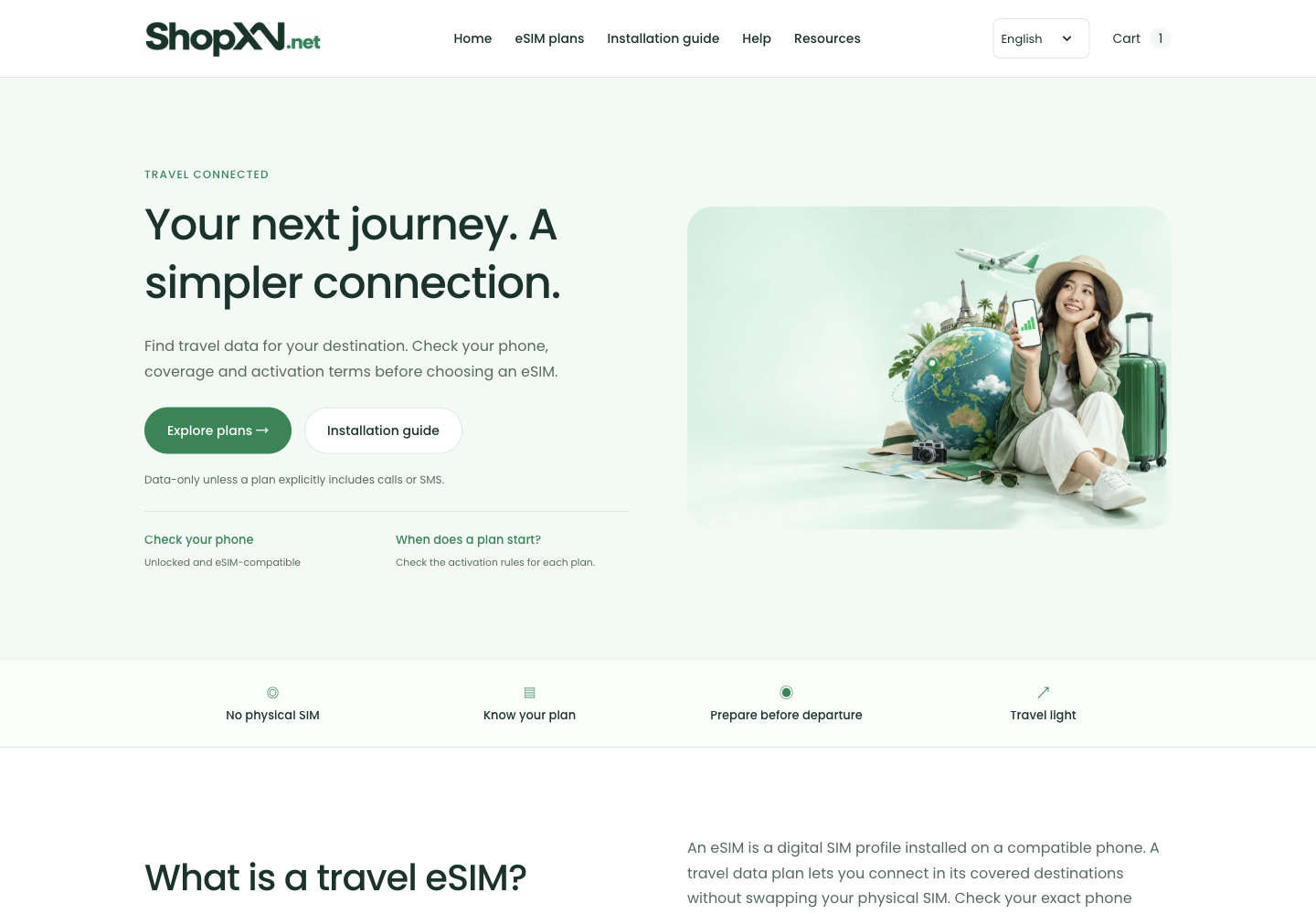
Captured: 13 October 2026 · 1440 × 1000
Visit the live page ↗View full-size screenshot ↗
- Project
- ShopXN.net · travel connectivity
- Architecture
- Shopify + independent content + business interfaces
- Public languages
- English and Simplified Chinese
Help travelers choose before they leave.
A travel data purchase involves more than choosing a country and a price. Travelers need to understand data allowance, validity, activation timing, device compatibility and the difference between a local operator contract and a roaming travel eSIM. The project brings product selection and explanatory resources into one site.
ShopXN.net serves travelers
The storefront presents destination plans and specifications. The resource library explains operators, device requirements and practical connectivity decisions, with links back to the relevant shopping and help pages.
ShopXN.com serves Shopify sellers
ShopXN.com presents system architecture and deployment services. ShopXN.net is a real, self-operated application of that approach—not an anonymous external-client testimonial. The audiences differ; the emphasis on usable systems and clear information is shared.
One domain. Three clearly defined layers.
ShopXN's role is to connect the storefront, content routes and business workflow without treating every responsibility as a theme feature. The storefront and independent publishing layer have different jobs, while language links and navigation make them one visitor journey.
Shopify commerce
Products, plan variants, cart and the checkout entry point belong to the commerce layer.
/products/ · /collections/allIndependent resources
Operator profiles, country information and travel guides have their own content layer on the same public domain.
/resources/Business interfaces
Interfaces connect order processing with digital-product delivery. Operational delivery needs separate order-level verification.
Order → processing → digital deliveryThis separation lets the resource library evolve without moving product selection into an article system, or treating an operator guide as a Shopify product. It also creates explicit responsibilities for routing, updates and failure handling.
Plan variants are part of the buying decision.
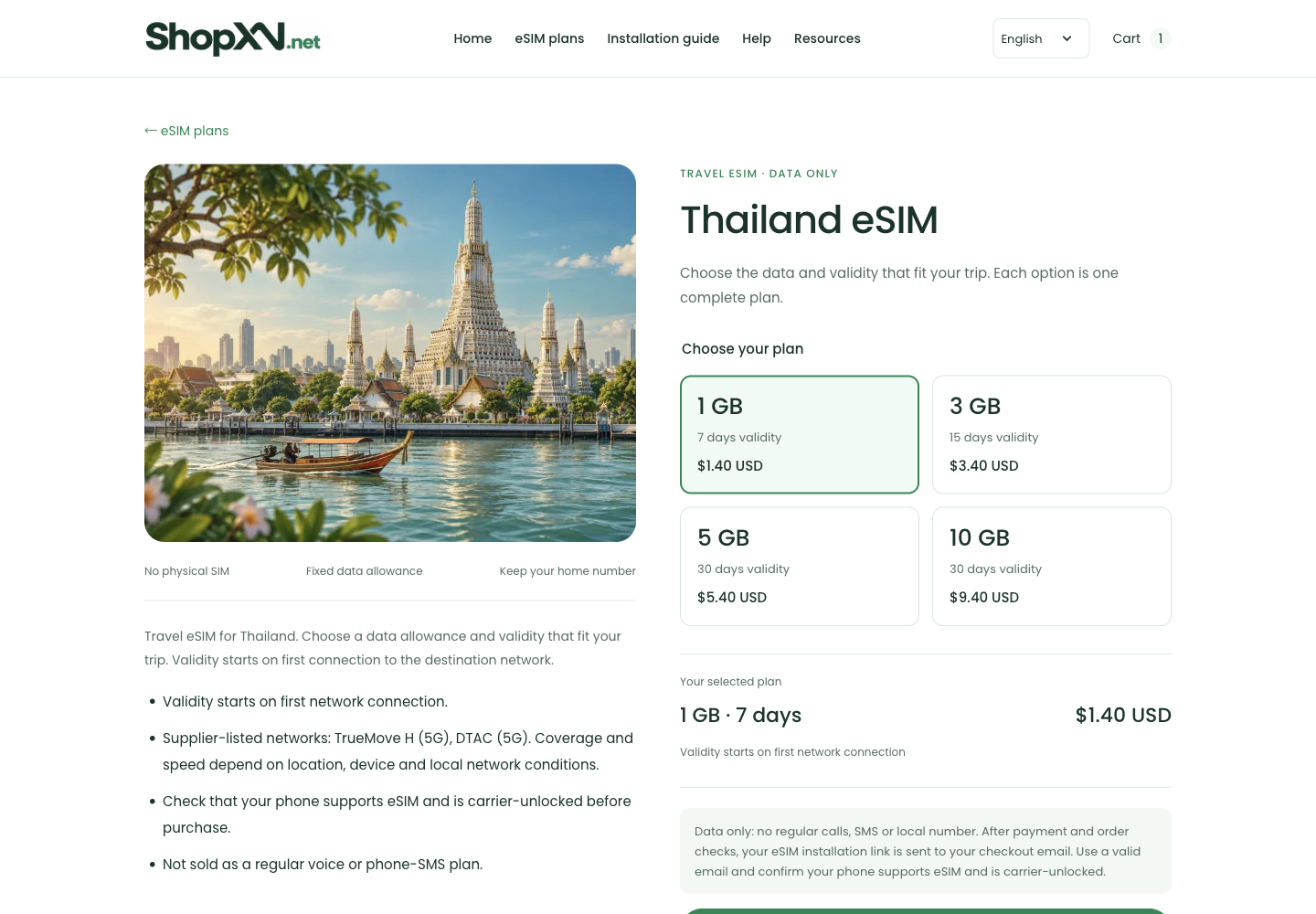
The Thailand product page shows how one destination product can offer several complete plans. Each option pairs a data allowance with a validity period and price, rather than asking the traveler to infer which combinations are valid.
- Plan selection and the selected-plan summary appear together.
- Device requirements, activation timing and the data-only limitation are explained alongside the product.
- Installation and help links remain available before a purchase.
Captured: 13 October 2026 · 1440 × 1000
Visit the live page ↗View full-size screenshot ↗
Snapshot status: on 13 October 2026, the checked Thailand product pages in English and Chinese showed an enabled Add to cart button and no checkout-maintenance notice. This was a read-only page check: no item was added, no payment was made and no delivery was tested. The screenshots demonstrate the interface, not a completed transaction. Availability can change; check the live product page.
A resource page answers a different question.
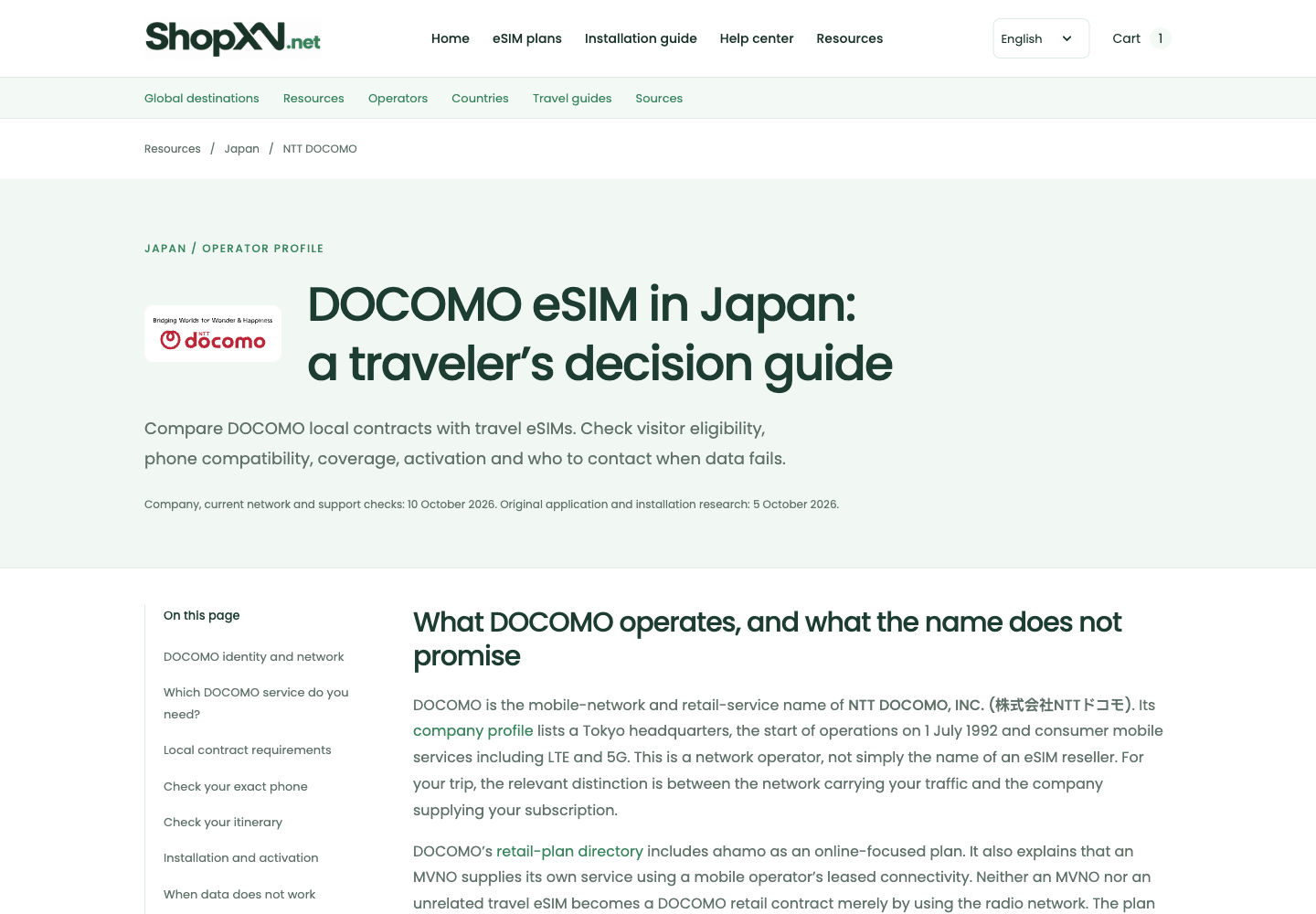
The DOCOMO guide helps a traveler distinguish a local Japanese contract from a travel eSIM that uses an operator's network. It addresses phone-number needs, application conditions, compatibility, coverage, activation and troubleshooting, with official-source links. It is an explanatory resource—not a claim that ShopXN is DOCOMO or has its endorsement.
Captured: 13 October 2026 · 1440 × 1000
Visit the live page ↗View full-size screenshot ↗
Connected without collapsing the two systems
The resource page includes storefront navigation and help links. English commerce uses the root path and English resources use /resources/; Chinese commerce uses /zh/ and Chinese resources use /resources/zh/. A visitor can move between shopping and research while retaining the relevant language.
The DOCOMO page is one inspectable example. It does not establish that every country or operator profile has been completed or independently reviewed.
Real interfaces. Transparent evidence boundaries.
The screenshots are actual English-language browser captures of ShopXN.net, not concept renders. They show the deployed storefront, a product with plan variants and an independently routed resource page. Each image links to the corresponding live page and its full-size capture.
Public pages can demonstrate visible content, routes and interface structure. Payment authorization, supplier purchasing, delivery receipts, refunds and failure recovery require separate operational evidence. This page publishes no unverified traffic growth, ranking gains, conversion figures or customer quotations.
For another Shopify business, the first step is to identify which responsibilities genuinely need a separate content or business layer. A native Shopify blog may already be sufficient; this project is an implementation reference, not a requirement to copy its architecture.
Start with the workflow your business needs.
Discuss your existing storefront, content workflow, languages and digital-delivery requirements. Use this real project to make the system boundaries concrete, then define the acceptance criteria for your own implementation.